Gootloader kenkėjiška programa naudojanti SEO
Federalinis tyrimų biuras (FTB) platina šį skubų pranešimą (FLASH), siekdamas paviešinti nustatytas taktikas, metodus ir procedūras (TTP), susijusias su kenkėjiška programa „Gootloader“. „Gootloader“ yra pirminės prieigos sistema (angl. initial access framework), kuri organizacijoms užkrėsti naudoja „JavaScript“ kenkėjiško kodo įkėliklį, nulaužtas svetaines ir paieškos sistemų optimizavimo (SEO) metodus. Kibernetiniai nusikaltėliai naudojo „Gootloader“ kaip išpirkos reikalaujančių programų (angl. ransomware) pirmtaką, atakuodami aukas įvairiuose sektoriuose. 2026 m. spalio mėn. duomenimis, FTB nustatė daugiau nei 1 000 užkrėstų „WordPress“ svetainių ir 216 domenų, kuriuos kontroliavo „Gootloader“ administratorius – tai lėmė daugiau nei 28 mln. JAV dolerių išpirkos mokėjimus. FTB ragina organizacijas susisiekti su biuru, jei jos buvo nulaužtos, ir įgyvendinti rekomendacijų skyriuje nurodytus veiksmus, kad sumažintų „Gootloader“ sukeltos kompromitacijos tikimybę ir poveikį.
Summary
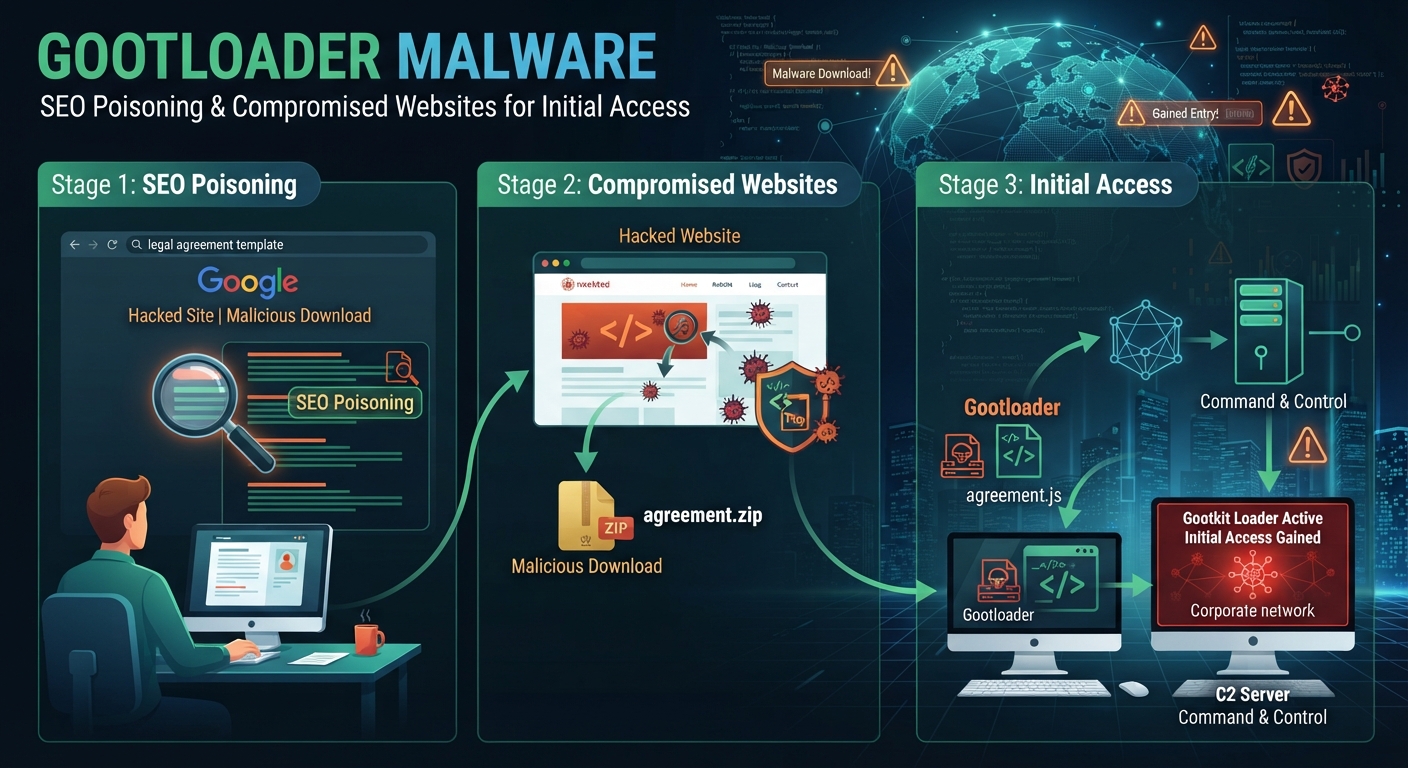
The Federal Bureau of Investigation (FBI) is releasing this FLASH to disseminate identified tactics, techniques, and procedures (TTPs) related to Gootloader malware. Gootloader is an initial access framework that uses a JavaScript malware loader, compromised websites, and search engine optimization (SEO) techniques to infect organizations. Cyber actors used Gootloader as a ransomware precursor to attack victims across a wide variety of sectors. As of October 2026, the FBI identified over 1,000 infected WordPress sites and 216 domains controlled by the Gootloader administrator, which led to over $28 million in ransomware payments. The FBI encourages organizations to contact the FBI if they have been compromised, and to implement the actions in the recommendations section to reduce the likelihood and impact of a compromise by Gootloader.
Threat
Between 2020 and 2026, the FBI observed cyber threat actors using Gootloader to obtain initial access to organizations through selected search phrases with low-ranking competition1, such as a jurisdiction-specific contract clause2. Using SEO, threat actor-controlled pages would appear next to legitimate resources. The Gootloader administrator scanned WordPress sites looking for xmlrpc.php3. The administrator then later used compromised credentials to breach systems. Gootloader used a traffic distribution system (TDS) to filter content by country, referrer, cookie, or IP address.
Gootloader compromised WordPress sites, which then acted as lure pages, redirectors, traffic filters, or relay infrastructure. Hidden keyword links and arranged backlinks were used to increase lure visibility. The Gootloader administrator used stolen credentials to access vulnerable plugins and themes, injected posts, XML-RPC, REST routes, and modified JavaScript.
Gootloader SEO search terms consisted of targeting practicing attorneys, in-house counsel, law firm partners, litigation and privacy teams, legal operations professionals, general counsel, and legal technology decision makers inside law firms or legal departments.
1 Search phrases that have a low search volume allowing for specific keywords targeted.
2 Search phrases and results driven by jurisdiction-specific legal language.
3 XML-RPC is a standard WordPress API endpoint frequently targeted by attackers for brute-forcing credentials.
Technical Details
Evolution of Gootloader
| Timeframe | Observed TTPs & Targeting |
|---|---|
| 2020 to 2021 | SEO-poisoned document searches; simulated forum pages; ZIP-delivered JavaScript; Windows Script Host execution. |
| 2022 to 2024 | Trojanized JavaScript libraries; AppData staging; use of PowerShell, scheduled tasks, and registry-resident payloads; continued use of SEO-poisoned searches. |
| 2025 to 2026 | Abuse of WordPress comment paths; geofencing and traffic distribution services; primary focus described as U.S. legal professionals and legal technology decision makers. |
Related Threat Actors Abusing WordPress
| Campaign | Scale and dates | How the site is used | Outcome for visitors |
|---|---|---|---|
| SocGholish (TA569), TA2726, Parrot TDS and other traffic brokers | Operation Endgame took down 106 servers and cleaned 14,971 WordPress sites (Jun 2026). From April to July 2026, there were 1,509 sites still active. | Injected JavaScript; fake plugin (platformist-quadendpointer) with a REST route /wp-json/<words>-<hex>/v1/<hex>; domain shadowing via hijacked DNS accounts |
Fake browser update; follow-on loaders, RATs and ransomware (Evil Corp, LockBit, RansomHub) |
| StopAndProtect | Thousands of sites; found mid-May 2026 | Hidden must-use plugins in wp-content/mu-plugins; concealed REST API upload endpoint with hard-coded credentials |
ClickFix; SilentEncryptor ransomware, stealers, SMB/USB worms |
| "Double Donut" stealer operation | 250+ sites in 12 countries | Remote script, inline script, or /wp-admin/admin-ajax[.]php?action=ajjs_run; skips visitors with admin cookies |
ClickFix; Donut loader, then Vidar, Impure Stealer or VodkaStealer |
| Fake Cloudflare lure | Active since Dec 2025 | Injected fake Cloudflare popup | In-memory shellcode; credential and crypto-wallet theft |
| ClearFake | Active Sep 2026 | Base64 <script> tag on index pages; payload pulled from blockchain smart contracts (EtherHiding), so it changes without re-touching the site |
ClickFix for Windows and macOS |
| DollyWay | 20,000+ sites since 2016; 10,000+ active Feb 2025 | Malicious and fake mu-plugins, WPCode snippets; hidden admin users with random hex names; reinfects on every page load | Redirects to scam pages |
Windows Utility Tools
| Source | Event | Purpose |
|---|---|---|
| PowerShell | 4103 and 4104; transcription where policy permits | Reveal Script Block creation, Invoke-Expression, AMSI patch strings, Assembly.Load, encoded loaders, and remote commands. |
| Windows Security | 4624, 4648, 4688, 4697, 4769, 5140, 5145 | Correlate network logons, explicit credentials, process creation, service creation, ticket requests, and admin share access. |
| System | 7045 | Detect transient remote service installation. |
| WMI Activity | 5857 through 5861 | Identify remote WMI providers, filters, and suspicious consumer or process behavior. |
| WinRM | Operational logs | Identify remote shell establishment and source or destination relationships. |
| Sysmon | 1, 3, 7, 8, 10, 11, 13, 22 | Process, network, image load, remote thread, process access, file, registry, and DNS visibility. |
| EDR | Memory, API, script, process lineage, network attribution | Detect hollowing, AMSI impairment, cross process writes, and in memory managed loads. |
WordPress Technical Protection
| Control | Implementation |
|---|---|
| Patching | Automatically update WordPress core and trusted plugins or themes where feasible; use virtual patching for emergency exposure. |
| Reduce attack surface | Remove unused plugins, themes, accounts, staging sites, and default components. Maintain a complete software inventory. |
| Protect administration | Require phishing-resistant Multi-Factor Authentication (MFA) or strong MFA for administrators and hosting access; use SSO or VPN restrictions where practical. |
| Restrict XML-RPC | Disable xmlrpc.php if unused. If required, rate-limit and allow only necessary methods or trusted integrations; monitor authentication and POST volume. |
| Constrain PHP | Run PHP as a non-privileged account, make core files read-only where practical, and deny PHP execution under wp-content/uploads. |
| Use least privilege | Separate hosting accounts and sites, limit database permissions, protect wp-config.php, and prevent one site from writing another site's files. |
| Deploy WAF controls | Use managed rules, bot protection, login throttling, file-upload controls, and alerts for new REST endpoints or unusual admin-ajax actions. |
| Monitor integrity | Compare core files with official checksums and alert on unexpected plugin, theme, mu-plugin, JavaScript, .htaccess, and index-file changes. |
| Monitor search abuse | Review Search Console and webmaster tools for unrelated legal or business queries, sudden indexed pages, manual actions, and security warnings. |
| Centralize evidence | Retain web access, WAF, authentication, control-panel, SFTP or SSH, database, DNS, and outbound connection logs outside the web server. |
Example of Hidden Keyword Links and Backlinks Used by Gootloader
String:
id="aaeetce"><ul><li><a href="2022/12/13/zoning-government-definition/index.html"Keywords:
- Zoning Government Definition
- York Region Police Requirements
- Wyoming Bule Sky Laws
- World No 1 Business Magazine
- Word Definition Solitude
- With Armour Legal
- Will Uk Abolish Inheritance Tax
- Why Should Legal Drinking Age Be 21
- Why is It agasint the Law to Drive without Shoes
- Why Can't the Cell Theory Become a Law
- Who Pays for legal Fees Election
- Who Is a Justice of the Supreme Court
- Who Branch Implements Laws
- Which Parent Will Get the Child Tax Credit
- Which of the Following Best Describes the Concept of Legal Jurisdiciton
- Which Command Is Used to change th e Definition of a Table in Sql
- Where is My legal Point of Discharge
- Where can I Llegally Bet on the Super Bowl
- When Was Divorce Legalized in Korea
- When did Sports Betting Become Legal in Virginia
MITRE ATT&CK Mappings
| ID | Technique | Tactic | Local evidence |
|---|---|---|---|
T1059.001 |
PowerShell | Execution | Most payloads are PowerShell templates or commands. |
T1027 |
Obfuscated Files or Information | Defense Evasion | Randomized names, string substitution, compressed or encoded payloads. |
T1140 |
De-obfuscate or Decode Files or Information | Defense Evasion | Base64, gzip, raw deflate, and runtime reconstruction. |
T1620 |
Reflective Code Loading | Defense Evasion | Assembly.Load executes managed payloads without a normal on disk assembly load. |
T1562.001 |
Impair Defenses | Defense Evasion | Patches AmsiScan Buffer. |
T1055 |
Process Injection | Defense Evasion | Writes into another process and creates a remote thread. |
T1055.012 |
Process Hollowing | Defense Evasion | Replaces a suspended process image. |
T1548.002 |
Bypass User Account Control | Privilege Escalation | Use a mock trusted directory and auto elevated executable. |
T1574.002 |
DLL Side Loading | Persistence or Privilege Escalation | Dll is placed next to copied easinvoker.exe. |
T1036.005 or T1036.006 |
Masquerading path or space | Defense Evasion | Mock C:\Windows trailing space path. |
T1047 |
Windows Management Instrumentation | Execution | WMI process creation and access testing. |
T1021.006 |
Windows Remote Management | Lateral Movement | Invoke-Command and TCP 5985 discovery. |
T1021.002 |
SMB Windows Admin Shares | Lateral Movement | C$ staging and low-level SMB authentication. |
T1569.002 |
Service Execution | Execution | Starts, and deletes remote services. |
T1078 |
Valid Accounts | Defense Evasion or Lateral Movement | Supplied credentials are used with WinRM, WMI, and SMB. |
T1550.002 |
Pass the Hash | Lateral Movement | NTLM hash is used directly for SMB authentication. |
T1558.003 |
Kerberoasting | Credential Access | SPN discovery and service ticket extraction to $krb5tgs$ format. |
T1003.002 |
Security Account Manager | Credential Access | Reg save of HKLM SAM and SYSTEM. |
T1003.004 |
LSA Secrets | Credential Access | SECURITY hive is export. |
T1087.002 |
Domain Account Discovery | Discovery | AD account and SPN enumeration. |
T1069.002 |
Domain Groups Discovery | Discovery | Group and SID collection. |
T1482 |
Domain Trust Discovery | Discovery | SharpHound |
T1018 |
Remote System Discovery | Discovery | AD computer enumeration. |
T1046 |
Network Service Discovery | Discovery | Tests 445 and 5985 across discovered computers. |
T1057 |
Process Discovery | Discovery | Enumerate processes and owners. |
T1082 |
System Information Discovery | Discovery | OS, product, architecture, and hostname collection. |
T1016 |
System Network Configuration Discovery | Discovery | IP address and interface context. |
T1033 |
System Owner User Discovery | Discovery | Current identity and process owner checks. |
T1090.001 |
Internal Proxy | Command and control | Reverse multiplexed proxy provides pivoting. |
T1071.001 |
Web Protocols | Command and control | HTTP and HTTPS GET and POST tasking. |
T1573 |
Encrypted Channel | Command and control | Custom RC4 like and XOR proxy channel; web traffic may use TLS. |
T1105 |
Ingress Tool Transfer | Command and control | Task content and bot code are transferred to endpoints. |
T1041 |
Exfiltration Over C2 Channel | Exfiltration | Can send selected data through a configured transfer path. |
T1567.002 |
Exfiltration to Cloud Storage | Exfiltration | Alternate upload uses bashupload.com. |
T1106 |
Native API | Execution | Windows memory, thread, process, and section APIs are invoked. |
T1070.004 |
File Deletion | Defense Evasion | Temporary scripts, services, and UAC artifacts are removed. |
T1587.001 |
Develop Capabilities: Malware | Resource Development | PHP builders generate customized implants. Applies to operator side capability. |
Recommendations
The FBI recommends organizations take the steps below to improve their security posture in response to the evolving entities targeted in this scheme. FBI recommends organizations also establish and maintain strong liaison relationships with the FBI Field Office in their region. Through these partnerships, the FBI can assist with identifying vulnerabilities and mitigating potential threat activity. The FBI further recommends organizations review and, if needed, update incident response and communication plans that list actions an organization will take if impacted by a cyber incident.
The FBI recommends network defenders apply the following actions to mitigate initial unauthorized access and harden security against future malicious attempts and compromises:
Windows Detection and Response
If a suspicious archive was downloaded but not opened
- Do not extract or preview its contents. In an organization, submit the file through the approved internal security process.
- Record the download URL, search query, browser history time, and filename.
- Delete the file only after the security team confirms evidence preservation is complete.
If the JavaScript file was opened
- Disconnect network access. Do not power off unless your incident-response procedure requires it.
- Use a separate known-clean device to change credentials after the security team scopes credential exposure. Do not change passwords from the suspected computer.
- Have responders collect endpoint memory when appropriate, process trees, scheduled tasks, autoruns, browser history, DNS, proxy records, and PowerShell logs.
- Reimage the endpoint when follow-on malware, credential theft, or persistence is confirmed. Removing only the downloaded file does not restore trust.
Windows prevention priorities
- Disable Windows Script Host where business applications do not require it, or control script execution with WDAC or AppLocker.
- Block unapproved scripts and executables from user-writable locations. Keep Microsoft Defender, SmartScreen, cloud protection, AMSI, and tamper protection enabled.
- Use standard user accounts, protected administrator workflows, browser download controls, attachment scanning, DNS filtering, and authenticated web proxy logging.
- Centralize PowerShell, Security, Sysmon or EDR, DNS, proxy, and firewall telemetry with enough retention to investigate delayed follow-on activity.
WordPress Response
Immediate response when compromise is suspected
- Place the site in a controlled maintenance state or restrict public access while preserving a forensic copy of files, database, logs, and hosting configuration.
- Reset hosting panel, SSH, SFTP, WordPress administrator, database, API, and CDN credentials from a clean system. Revoke active sessions and application passwords.
- Identify the initial access path. Restore from a known-clean backup only after removing the vulnerability or stolen credential that allowed entry.
Reporting Notice
The FBI encourages any suspected Gootloader intrusions to be reported to their local FBI field office at www.fbi.gov/contact-us/field-offices or 1-800-CALL-FBI (225-5324) or to the FBI Internet Crime Complaint Center at www.ic3.gov.
When available, each report should include the date, time, location, type of activity, number of people, and type of equipment used for the activity, the name of the submitting company or organization, and a designated point of contact. Press inquiries should be directed to the FBI's National Press Office at npo@fbi.gov or (202) 324-3691.
Retain all information regarding the incident, including affected package names and versions, network logs, credentials or secrets potentially exposed, and any extortion communications or ransom demands. When available, include the date and time the compromise was discovered, estimated date of initial infection, type of activity observed, systems and environments affected, name of the submitting company or organization, and designated point of contact.
Your organization has no obligation to provide information in response to this product. If, after reviewing the information provided, your organization decides to provide information to the FBI, it must do so consistently with applicable state and federal law.
Administrative Note
The information in this document is being provided by the FBI, with no guarantees or warranties, for potential use at the sole discretion of recipients to protect against cyber threats. This data is provided to help cybersecurity professionals and system administrators guard against the persistent malicious actions of cyber actors. The FBI does not endorse any commercial entity, product, company, or service, including any entities, products, or services linked within this document. Any reference to specific commercial entities, products, processes, or services by service mark, trademark, manufacturer, or otherwise, does not constitute or imply endorsement, recommendation, or favor by the FBI.
This FLASH was coordinated with DHS/CISA and is marked TLP: CLEAR.
Your feedback regarding this product is critical. Please take a moment to complete the survey at https://www.ic3.gov/PIFSurvey. Input can be submitted anonymously and should be specific to your experience with our written products. This survey is for feedback on contact and value only. Reporting of technical information regarding FLASH reports must be submitted through your local FBI field office.
TLP: CLEAR